Timing is everything when sourcing custom luggage. Whether you are launching a new travel brand, managing inventory for a retail chain, supplying wholesale markets, or expanding an Amazon storefront, understanding production lead times is critical. Miscalculating your timeline can lead to stock shortages, missed peak-season sales, and inflated emergency logistics costs.
One of the most frequent questions global buyers ask us is:
"How long does it take to produce custom luggage?"
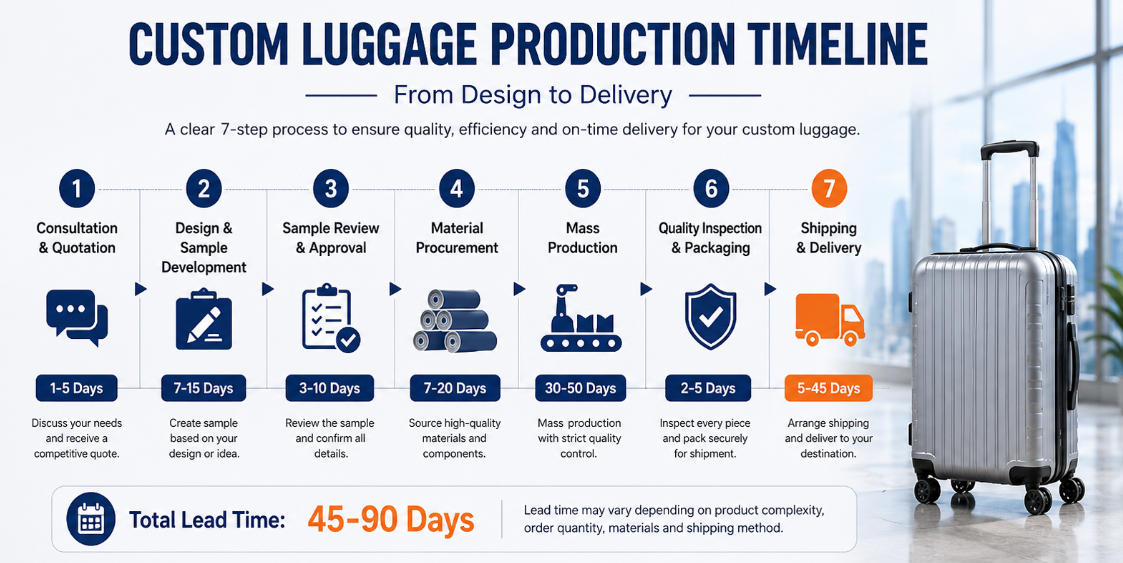
The short answer is that most custom luggage projects require 45 to 90 days from initial concept approval to finished goods ready for shipment. However, the exact timeline depends heavily on product complexity, material availability, order quantity, and structural customization.
This comprehensive guide breaks down the complete luggage manufacturing timeline, identifies potential bottlenecks, and shares actionable strategies to streamline your supply chain and get your products to market on schedule.
Unlike purchasing standard off-the-shelf inventory, manufacturing custom luggage involves multiple meticulous development and production stages.
Below is a realistic timeline breakdown for a typical OEM/ODM luggage project:
| Production Stage | Typical Lead Time | Key Focus |
| Product Consultation & Quotation | 1–5 Days | Defining specs, choosing materials, and cost estimation. |
| Design & Sample Development | 7–15 Days | Creating prototype to verify aesthetics and structure. |
| Sample Review & Approval | 3–10 Days | Buyer evaluation, feedback iterations, and final sign-off. |
| Material Procurement | 7–20 Days | Sourcing shells, linings, wheels, zippers, and hardware. |
| Mass Production | 30–50 Days | Shell forming, assembly, sewing, and bulk manufacturing. |
| Quality Inspection & Packaging | 2–5 Days | Drop tests, hardware checks, and retail-ready packing. |
⚠️ Note: If your project requires proprietary shell designs or exclusive branding elements that necessitate new tooling/molds, you should budget an additional 20–45 days for mold development and testing before Stage 2 begins.
Every successful project starts with a crystal-clear tech pack. To provide an accurate quote and avoid costly revisions later, the manufacturer will confirm:
💡 Pro Tip: Buyers who provide detailed sketches, technical 3D drawings, or physical reference samples can radically shorten this stage, often receiving quotations and feasibility feedback within 48 hours.
If you are still mapping out your business model, read our companion guide on How to Start Your Own Luggage Brand for foundational insights.
Sampling bridges the gap between digital concepts and physical reality. It allows you to test structural durability, color accuracy, and overall user experience before unlocking capital for mass production.
The sampling timeline varies drastically based on the level of customization:
Once the prototype arrives at your office, you will evaluate it for functional performance, aesthetic appeal, and packaging.
Supply Chain Insight: Extended sample revision cycles are the #1 cause of product launch delays. To keep your timeline tight, aggregate all feedback from your design, marketing, and QA teams into a single, consolidated revision cycle.
Bulk production cannot start until 100% of the components arrive at the factory floor.
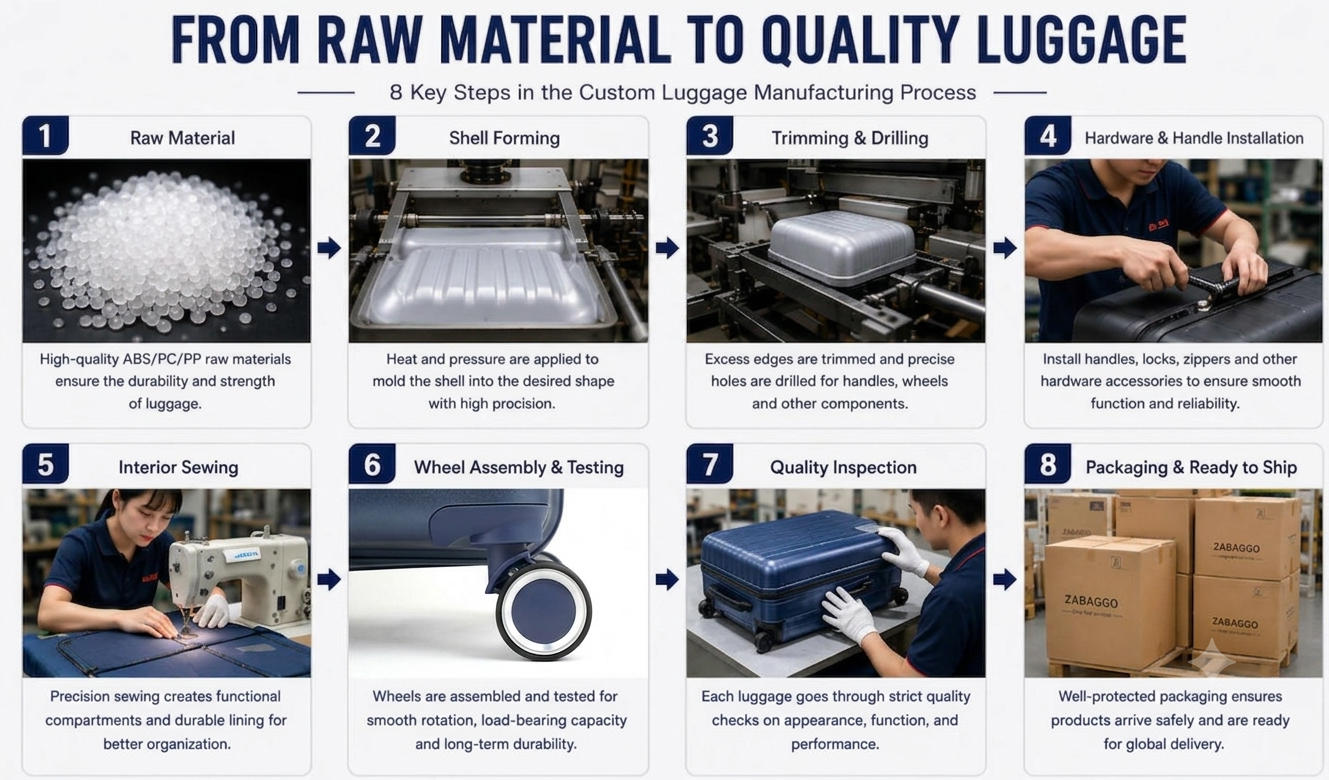
This is where raw materials transform into finished goods through a highly synchronized assembly line: shell vacuum-forming, automated CNC edge-trimming/drilling, hardware riveting, wheel/handle installation, interior lining sewing, and final detailing.
Bulk production schedules scale with order volume:
1. Design Changes Mid-Production: Requesting structural changes after material procurement halts assembly lines and causes compounding delays.
2. Peak Manufacturing Seasons: Factories experience severe capacity crunches ahead of major global retail events:
3. Strict Customs & Compliance Testing: If your target market requires specific chemical (REACH/RoHS) or physical compliance certifications, factor in laboratory testing turnaround times.
Your go-to-market plan must account for transit times after the goods leave our loading dock. Depending on your budget and urgency, choose from the following shipping methods:
1. Express Courier (3–7 Days): Best reserved for urgent market samples or high-value components.
2. Air Freight (5–12 Days): A balanced option for high-end, time-sensitive product launches.
3. Sea Freight (Most Cost-Effective for Bulk):
If you need to fast-track your product launch, implement these industry best practices:
1. Leverage Open-Mold Formats: Utilize the factory’s existing, pre-tested shell molds. You can still create a unique brand identity through bespoke colors, high-end hardware, and premium interior linings.
2. Lock In Specs Early: Avoid the temptation to tweak designs once the purchase order (PO) is signed.
3. Establish a Rapid-Response Feedback Loop: Fast-track sample approvals internally to maintain production momentum.
4. Forecast and Order Counter-Cyclically: Place bulk orders 4–6 months ahead of your peak retail season to lock in lower raw material costs and guaranteed factory capacity.
5. Partner with an Integrated Manufacturer: Choose a manufacturer with a robust, localized supply chain matrix and in-house QA capabilities to eliminate external logistical delays.
What is the absolute fastest way to launch a custom luggage line?
The fastest route is choosing an existing ODM design and customizing it via private labeling (logo print, custom inner lining, and bespoke packaging). This can cut your overall production time down to 30–45 days.
Does the choice of material impact production speed?
Yes. Standard virgin ABS and PC are highly accessible. Premium components like aluminum-magnesium alloy frames, custom color-matched plastics, or specialized anti-theft zippers require custom supplier fabrication, which adds 7–10 days to the procurement phase.
What is the typical Minimum Order Quantity (MOQ) for custom luggage?
While MOQs depend on the customization depth, standard OEM luggage projects generally start at 100 to 500 pieces per model/color.
Is OEM or ODM manufacturing faster?
ODM (Original Design Manufacturing) is faster. Because the manufacturer has already engineered, molded, and stress-tested the structural designs, you bypass the lengthiest product development phases. Learn more about choosing the right path in our deep-dive: OEM vs ODM Luggage Manufacturing: Which Option Is Best for Your Business?
Bringing a custom luggage line to market requires balancing art, engineering, and timeline management. For most established brands and agile e-commerce retailers, mapping out a realistic 45-to-90-day production window provides the safety margin needed to protect your brand reputation and ensure flawless product execution.
Streamline Your Supply Chain with Zabaggo
At Zabaggo, we manufacture high-performance OEM and ODM luggage for global brands who cannot afford to compromise on quality or delivery timelines. Backed by an agile development team, an integrated supply chain network, and strict quality control standards, we turn complex luggage concepts into market-ready realities—on time, every time.
Whether you are launching your debut collection or scaling up retail distribution, let's optimize your production schedule. [Contact the Zabaggo Team Today] to request a quote and a complimentary lead-time assessment for your project.
Related Resources
